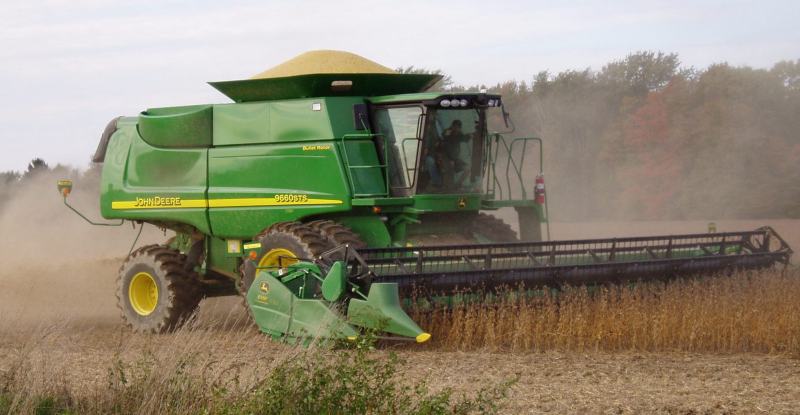
Amie here. Harvest time is upon us, and Iowa farmers are supposed to have the third-largest harvest on record.
Yet it all amounts to a hill of beans (literally) if nobody’s buying them.
Iowa soybean farmers—and those in the wider ag industry—are hurting in a big way, and they’re not getting any relief with President Donald Trump’s continued trade war with China.
It all started with the initial trade war Trump initiated in 2018:
- Before then, the US shipped an average of $12.8 billion worth of soybeans to China.
- After Trump imposed tariffs on foreign imports from China in January of 2018, that dropped to $4.7 billion, a more than 60% decrease, according to the American Soybean Association.
- Since May, after Trump threatened different tariff levels on the country, that dropped to zero. China is now buying soybeans mostly from Brazil.
Net cash farm income has plummeted 40% for soybeans, to the lowest level it’s been in 15 years. And that’s before this year’s harvest.
It’s not like there’s another buyer that’s comparable to China, which is by far the largest market for soy—they consume 61% of the world’s total soy per year on average. The next closest buyer is the European Union, and they only buy around 11%.
Iowa’s definitely affected by this—we produced nearly 600 million bushels of soybeans in 2024, or around 14% of America’s total soybean export crop. There’s always some that’s going unsold, usually around a third of the crop. But up to 60% of last year’s crop is estimated to go unsold, according to the Iowa Soybean Association.
And this year, nobody knows.
I mean, you have the president of the Iowa Farmers Union saying local elevators—where farmers sell and store their crops—are in some cases refusing to take soybeans because of the uncertainty. Prices are down, in some cases up to $2 a bushel, from the same time last year, while inputs—things like equipment, fertilizer, etc.—are up.
Even if you’re not farming, that hits Iowa hard. A fifth of our workforce is employed in the broader agriculture sector, accounting for 22% of our state’s economy.
And we’re already hurting: The Iowa Farm Bureau found in November that around 11,400 Iowa workers have been laid off across farm equipment manufacturers, food processors, and other agriculture-related businesses.
That’s $1.5 billion of the state’s overall economy, gone.
At John Deere alone, 1,600 workers were laid off in 2024 because of the first ag downturn, according to the company. And they think they’ll lose $600 million just because of this year’s tariffs alone.
Already this year (I added it up from the Iowa WARN Act site), 457 workers have been laid off at Deere plants around the state.
And just this week, Deere announced another 101 Waterloo workers and 40 Ankeny workers will be laid off next month.
There’s around $66 billion earmarked in farm safety net money from the “Big Beautiful Bill,” but that’s a bandage on this larger problem.
Farmers are, for the most part, pretty conservative, and pretty reliable Trump voters. Many of the farm associations are regular donors to Republicans. Yet Trump’s just slow walking a deal—last I saw, he’s pushed more China trade talks to mid-November.
What should President Trump be doing to help Iowa farmers? Email me.