Iowa Republicans want public schools to offer elective coursework teaching the Christian Bible. Supporters say teaching the Bible as literature is essential to an education. Schools can already offer these classes, but Republicans say that’s not enough.
In the beginning, Democratic State Sen. Sarah Trone Garriott of West Des Moines asked a question: does Iowa Code prohibit public schools from studying religious literature?
The answer is no. But why would that stop Senate Republicans from creating a separate process in the public school system aimed at increasing the study of their religious text.
Senate File 138, which advanced through a Senate subcommittee Thursday, would authorize school districts to offer elective courses on the Christian Bible. It’s a nearly word-for-word copy of a 2018 bill that never made it out of committee.
Notably, the bill does not open this process for districts to offer courses on other religious texts, effectively directing the state to privilege one religion over another. Lizzie Gillman, an Episcopal priest at St. Andrew’s Episcopal Church in Des Moines, warned the bill could advance Christian nationalism, the belief that Christians should dominate the political and cultural life of the country.
“This is very serious to me and this is very serious to other faith leaders in the room. I do not want to shove anybody’s faith down anybody’s throat,” Gillman said.
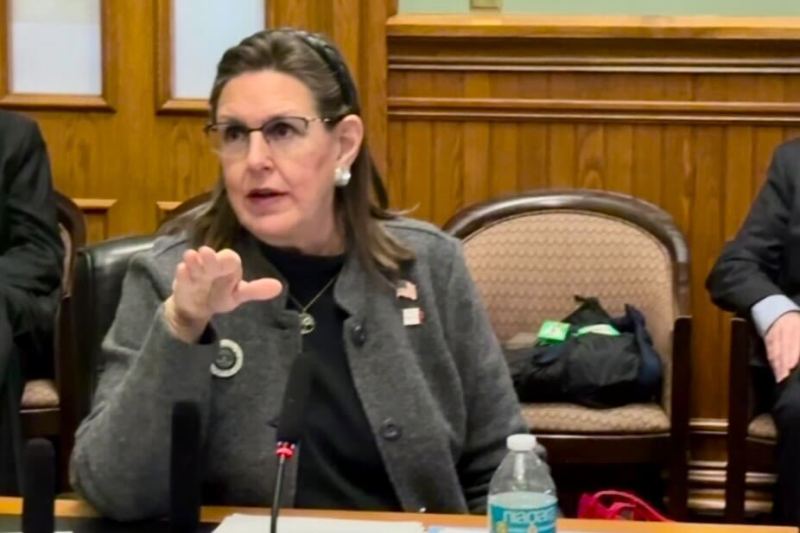
To prove the need for the bill, subcommittee chair Sen. Sandy Salmon of Janesville brought University of California, Long Beach professor William Jaynes to testify about his own research looking into the impact of “biblical literacy” on academic performance.
“It’s hard to imagine a person being regarded as educated unless they have at least a working knowledge of the Bible,” Jaynes said.
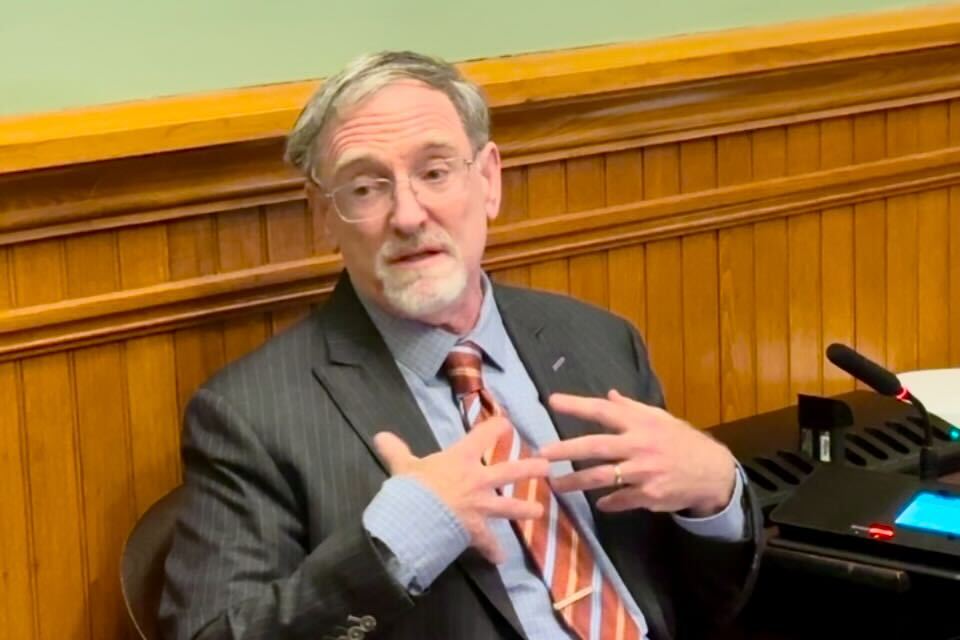
While Jaynes explained his background as an academic to the subcommittee, he conveniently didn’t mention his work as an evangelist for The General Council of the Assemblies of God, a large Pentecostal sect of Christianity; or his personal ministry under the banner of God’s Love Ministries. The Iowa Senate bill fits neatly into Jaynes’ mission to infuse publicly funded schools with more Christian religious education. He laid out his ministerial thesis in a profile published to the Assemblies’ website.
“But I came to the conclusion that while ministers definitely make an impact, so do public schools,” Jeynes said. “Public schools have our kids five days a week. Those kids are attending church, at most, three times a week.”
Not all of the bill’s support was out-of-state. Chuck Hurley, a lobbyist for The Family Leader, said the Bible is “a special book. To deprive students of this resource, to not advocate for students to read this resource, is neglect.” Pointing to Jaynes, Hurley added, “It leads to a poorer education from a very secular standpoint.”
“God sent his son to die for us. That’s in the Bible. How are you going to argue with that? It’s the basics,” Paul Dykstra of Milo said. “So I’m in favor for this bill to go forward and let the students have the opportunity. They need to have the opportunity to learn the Bible, to study the Bible on their own.”
The bill’s opponents brought up several issues they had with it. First, as Trone Garriott implied in the beginning of the meeting, there is nothing in Iowa Code that prevents a public school teacher from analyzing a section of the Christian Bible to teach literature or history or culture.
Trone Garriott, herself a Lutheran minister, also criticized the bill’s narrow focus. “If this bill provided for a survey of religious texts from major religions and their impact on history and culture, it would be valuable,” she said. “But it only features one religious community’s scriptures.”
Finally, even the texts named by the bill—the “Hebrew Scriptures,” often called the Old Testament, and the “New Testament”—could refer to any number of translations, arrangements and assemblies. Brigit Stevens, a minister with the United Church of Christ, opposed the bill saying the Christian Bible can refer to many different books elevated by different denominations of the religion.
“I’m curious which Christian Bible are we talking about, the Catholic or Protestant? There’s a difference in which pieces are included. The words that you offered for us continue to say ‘the Bible as literature.’ Well, the Bible is actually a collection of many books, 66 or more, depending on your faith tradition.”