Iowa’s meatpacking history is an essential part of the state’s overall story. Here’s why.
Meatpacking has been one of Iowa’s biggest, most successful industries for over a hundred years. It became more prominent during the 1920s and into the 1940s due to profitable wartime contracts, but the overwhelming presence of cattle and hog raising farms throughout the state initially led to this prosperity. Sioux City, due to its location between three hog and cattle-raising states and its proximity to nearby railroads, became one of the biggest contributors to the success of the state’s meatpacking plants.
Then, of course, came the Rath Packing Company, which propelled Waterloo into an equally abundant source of revenue. Modern technology, like refrigerated railroad cars, further contributed to the meatpacking industry’s boom. Being able to ship refrigerated meat meant expanding into markets across the country and around the world. However, it wasn’t just Iowa’s proximity to hog and cattle farms, or refrigerated shipping containers, that contributed to its profitable meatpacking history. Most of its success came from the people who worked inside these plants and the unions that were established to support them. Though the unions themselves would go on to work against the employees later down the line (more on that here), many of those created in the late 1940s assisted workers in receiving fair wages and helped in the fight against segregation.
One of the most important unions at the time was the United Packinghouse Workers of America (UPWA), which focused on building worker and racial solidarity side by side. Many Black workers moved from the deeply segregated and prejudiced South to Iowa for better opportunities and more inclusion, and the UPWA played a hand in maintaining these ideals. White union members would go to restaurants across Waterloo and place their orders, then wait for Black workers to come in and do the same. If the restaurant refused to serve the Black workers, the white workers would walk out of the establishment alongside them. The UPWA also advocated for Black workers throughout the 1960s when discrimination crept into the workplace and ensured that these issues were addressed immediately and successfully.
Before we dive into the history behind two of Iowa’s meatpacking plants and how they prospered—then eventually petered out—it’s important to emphasize how the workers were the lifeblood of these companies. Many stayed with the plants for decades and were able to build good lives for themselves with the wages they earned there. They were the ones clocking in and out every single day, even during wartime (women helped carry the load then, as they did across several industries), to ensure that families were being fed and needs were being met. Iowa’s meatpacking history would not have been what it was without them.
The Rath Packing Company, Waterloo
It’s impossible to discuss Iowa’s meatpacking history without discussing the Rath Packing Company. It was originally started by George John Rath in February 1891, shortly after his previous pork packing plant burned down in Dubuque. George, along with his son Edward, worked with the Waterloo Board of Trade to negotiate a deal for land, tax concessions, and thousands of dollars in capital to start. After a deal was finalized, though, George ultimately decided to stay in Dubuque. Edward took the offer from the Waterloo Board of Trade and set out to open the factory alongside George’s cousin, John Rath.
When Edward and John arrived in Waterloo, their plans were originally centered on processing hogs at the plant (due to the aforementioned abundance of hog farms in the state). These plans were prosperous, and the Raths went on to add both lamb and beef processing operations throughout the 1900s. What began as a 22-man operation expanded into one of the largest meatpacking plants in the country. Waterloo was dubbed “Factory City” due to the Raths incorporating technological advancements, like dry-curing bacon and vacuum-canning meats, during World War I and World War II. It was through these advancements that the company began processing and selling two of its most popular items, Tend’r Ham and Black Hawk Bacon, the sales of which led to further prosperity.
After World War II, the Rath Company experienced a continuous business boom for several years. It experienced some minor shakiness amid labor disputes in the late 1940s, but throughout the 1950s, the plant still employed thousands of workers, many of whom were Black. The plant’s union helped negotiate considerable wages for its workers—according to ProPublica, employees were receiving what would now be the equivalent of $24-32/hour. The publication noted that these wages helped establish Iowa’s Black middle class.
However, the Rath Company began to suffer in the 1960s and ‘70s alongside other meatpacking plants when pork consumption started to decline. Additional issues, such as more competitors, tighter profit margins, and a shift from multi-level plants to single-level ones, also contributed to Rath’s financial decline. Despite the employee’s best efforts to keep the business alive, it was ultimately liquidated and closed in 1985.
Farmstead Foods, Cedar Rapids
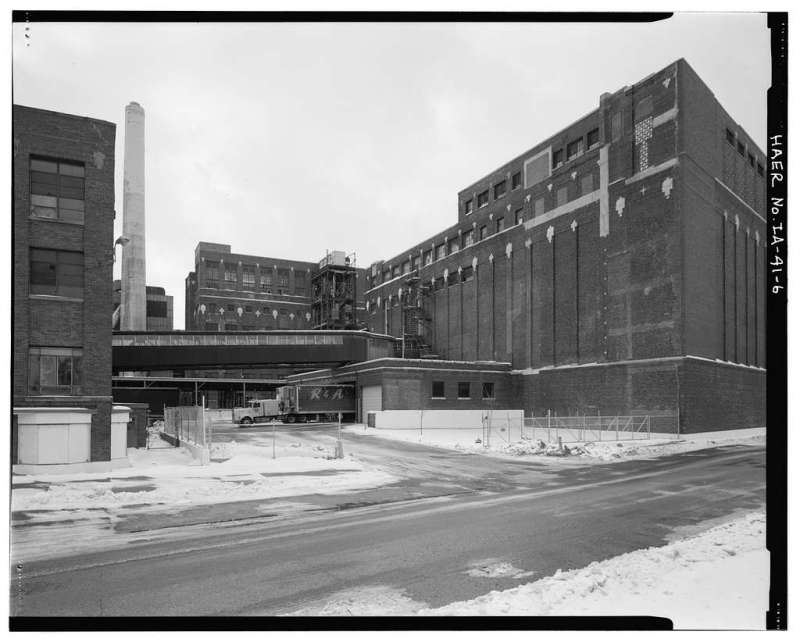
Farmstead Foods was founded in 1871 as T.M. Sinclair & Co. Much like the Rath Packing Company, T.M. Sinclair quickly became one of the largest meatpacking plants in the country due to its popular canned products and chopped beef, along with its bountiful wages.
In 2010, 87-year-old Helen Persson spoke with The Gazette about her 27-year career there, saying, “It was one of the best-paying places in town at one time.” One of her coworkers, Marjorie Blevins, told the outlet that she was able to pay for college tuition for all three of her sons through the money she earned at the plant. It remained one of the biggest employers in Cedar Rapids for decades.
Eventually, T.M. Sinclair became Wilson & Co. and then Farmstead Foods. With each new iteration of the company came additional stories of employees who enjoyed their time working there (thanks, in part, to union benefits). Before Farmstead Foods closed its doors for good in 2010, Jessie Taken told the Gazette that during their time at the plant—when it was known as Wilson & Co.—“Everyone had nicknames. We were all family down there. We had a wonderful group of people.”
This article first appeared on Good Info News Wire and is republished here under a Creative Commons license.
Related: WATCH: New meatpacking facility brings back jobs to Perry, Iowa