Iowa House Republicans advanced a bill to remove gender identity from the list of protected classes under the Iowa Civil Rights Act. This has wide-ranging impacts on protections from discrimination in housing, education and more. The bill became the subject of the largest Iowa Capitol protest all session.
Since passing in 2007, transgender Iowans have had protections from discrimination in employment, housing, education, and public accommodation. But a new effort by Iowa Republicans would strip those protections from state law, opening the door for widespread discrimination of trans Iowans.
On Monday morning at the Iowa State Capitol, the first floor was crowded with protesters. Behind a door, a subcommittee was holding a public hearing on the new bill. Chants inside were loud enough to bring the meeting inside to a halt.
Protesters wanted the committee to reject the bill and preserve these civil rights protections. Among them was Johnson County Supervisor V Fixmer-Oraiz, Iowa’s first trans elected official.
“It is incumbent upon the government to affirm our access and right to life, liberty, and the pursuit of happiness. For the government to then actually try to remove protections from one group of people—my people—is absolutely, purely hatred,” Fixmer-Oraiz said.
Also among protestors was retired physician Pauline Miller, who said she had LGBTQ+ patients decades ago that struggled with their identities.
“We need to celebrate the progress we’ve made,” Miller said. “That individuals who are gay, lesbian, trans can say ‘this is who I am, and I can love myself and be a part of a community.’”
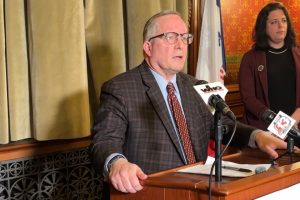
But their pleas did not change subcommittee chairman Rep. Steve Holt’s mind.
“Transgender individuals just like every other American are protected by the United States Constitution, the Bill of Rights, the Iowa Constitution in the case of Iowans and Iowa law. The effect of putting the transgender… gender identity as a protected class in the Iowa Civil Rights Code has elevated their rights above others and infringed on their rights,” said Holt, a Republican from Denison.
Holt said his concerns were for trans women being included on women sports teams. He did not cite any Iowa examples of transgender inclusion impacting Iowans negatively. And in his rush to get a definition for man and woman, Holt made a miscalculation.
“We define ‘male’ as someone who produces sperm because that is true. We define ‘female’ as someone who has ova because that is true,” Holt said. “We are standing up for truth in this legislation.”
The truth is approximately 1 million women each year experience menopause, which occurs when the ovaries run out of eggs to release. This happens naturally over the course of a lifetime. Since these menopausal women have run out of eggs and don’t start producing sperm, it seems they’re locked out of Holt’s male and female definitions. So too are men who don’t produce sperm, which impacts 1% of men.
The new bill would define “sex” as “the state of being either male or female as observed or clinically verified at birth” and specifies that “gender” should be considered a synonym for biological sex, not gender identity. HSB 242 goes beyond removing civil rights protections to also regulate the identification of sex on birth certificates. It also would erase the phrase “gender identity” in educational contexts and replace it with the phrase “gender theory,” prohibiting instruction about so-called “gender theory” in schools from kindergarten through sixth grade.
Now that it has been advanced by a subcommittee, it can be taken up by the full Judiciary committee also chaired by Holt. To become law, it needs to be approved by both the Iowa House of Representatives and Senate, as well as receive a signature by the governor.